
L. Alejandro Giraldo
Plant Biologist, Paleobiologist
Ph.D. Candidate
Department of Geosciences, The Pennsylvania State University
[email protected]
Research
I study fossil plants to understand how ecosystems have evolved through geologic time.Through field- and museum-based research across the Americas, Australia, and Southeast Asia, I investigate fossil floras to trace the evolution of plants and plant-insect interactions, reconstruct biogeographic connections, and understand how ancient forest assembled.Beyond research, I'm passionate about sharing science through teaching, mentorship, and outreach.Check my work here.
About
I had the fortune to be born and raised in Colombia, a country filled with lush, green forests. I remember long hikes with my siblings, mesmerized by dense mist clinging to tree bark and the endless variety of shapes, colors, and aromas around me. That appreciation for nature —passed down by my mom— became one of the main reasons I pursued a biology degree at the Universidad EAFIT.
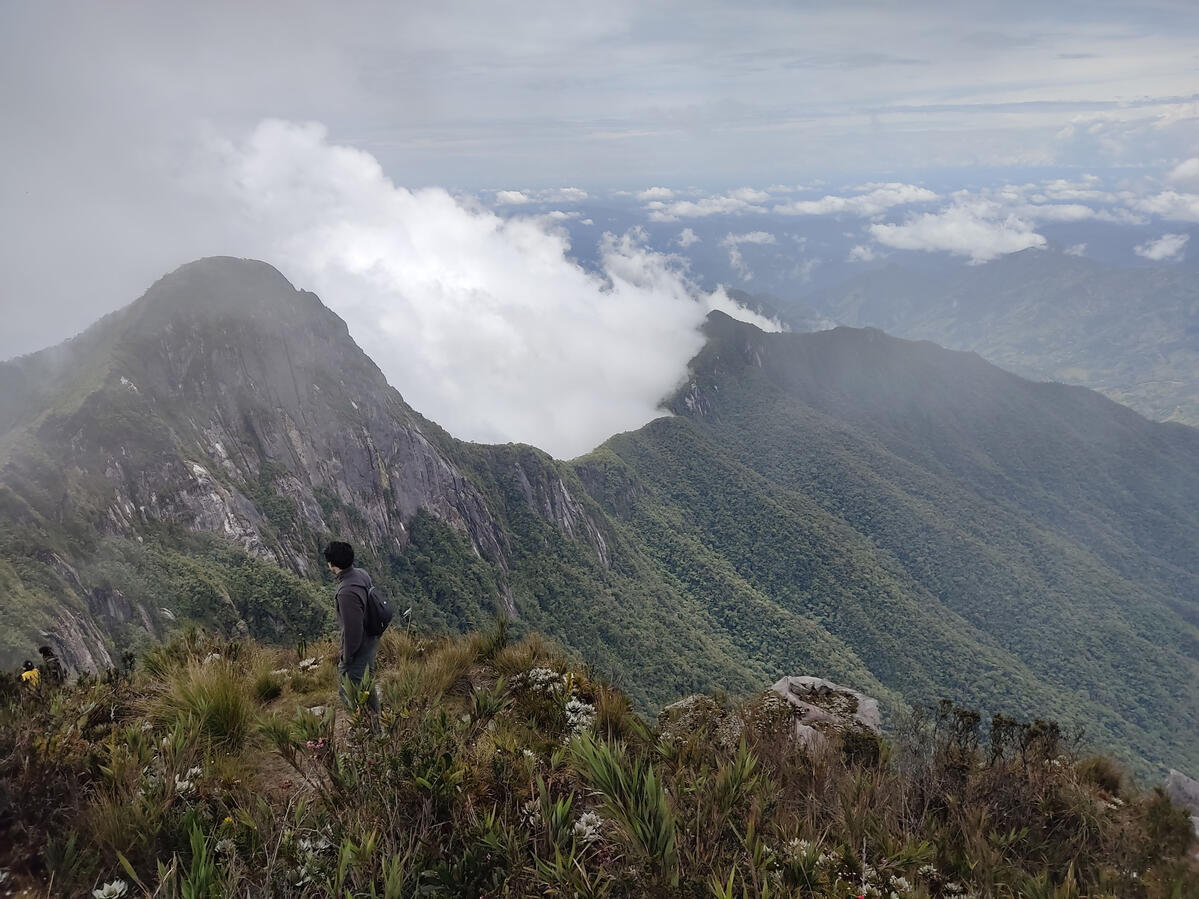
Páramo de Sonsón, Antioquia, Colombia
During my third year as an undergrad, a paleontology class hooked me instantly. I hadn't known fossil plants existed, and I was drawn to their strangeness and to timescales my brain still struggles to grasp. For my undergrad thesis, and as a Short Term Fellow at the Smithsonian Tropical Research Institute, I studied insect-feeding traces on some of the earliest Neotropical rainforests —the closest we can get to reconstructing plant-insect ecology 58 million years ago. I was mentored by Dr. Mónica Carvalho.
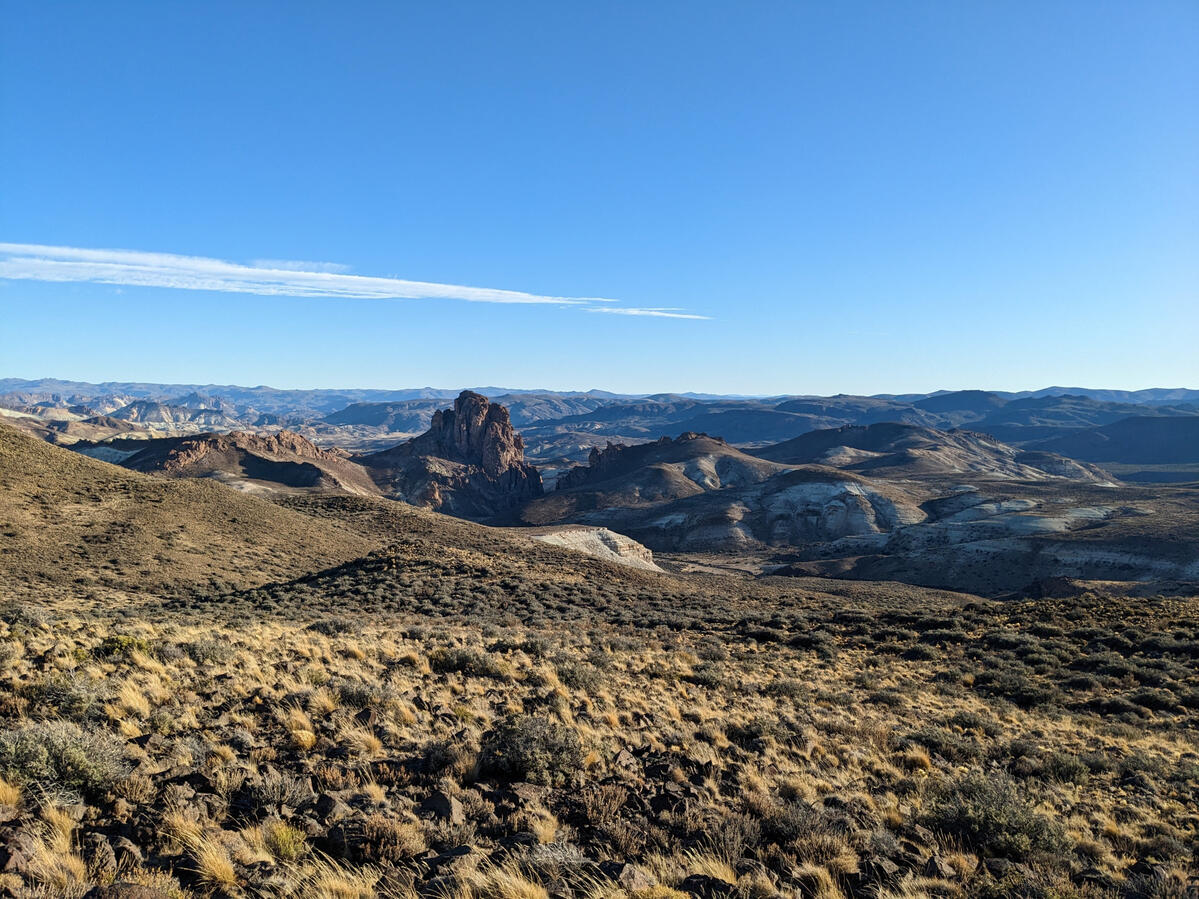
Laguna del Hunco, Chubut Province, Patagonia, Argentina
I moved to Penn State for an M.S. with Dr. Peter Wilf, testing whether insect herbivory on 52-million-year-old Eucalyptus leaf fossils from Patagonia matches the traces observed in living gum trees. I stayed on for my Ph.D., where I now describe fossils from the Eocene Anglesea flora of southeastern Australia, study how Australian rainforests assembled through time, and test whether stomatal measurements can reliably estimate ancient humidity.Check more of my work here
Publications
Also find them on Google Scholar and ResearchGate
Wilf, P., Giraldo, L.A., Korasidis, V.A., Carpenter, R.J. (2026). Dilleniaceae leaf fossils from Late-Gondwanan Australia challenge biogeographic and paleoclimatic assumptions. International Journal of Plant Sciences 187, [pagination TBD] https://doi.org/10.1086/741476Giraldo, L.A. (2025). Comparisons of insect and pathogen leaf damage on early Eocene Eucalyptus (Myrtaceae) from Patagonia and extant Australasian gum trees. PhytoKeys, 266, 177–217.Giraldo, L.A., Wilf, P., Donovan, M. P., Kooyman, R. B., Gandolfo, M. A. (2025). Fossil insect-feeding traces indicate unrecognized evolutionary history and biodiversity on Australia’s iconic Eucalyptus. New Phytologist, 245, 1762–1773.Spagnuolo, E. J., Giraldo, L. A., Coiro, M., Lydon S. (2024). Reconstructing the botanical past: art and paleobotany. Plant Science Bulletin, 70, 264–276.Giraldo, L.A., Carvalho, M.R., Herrera, F., Labandeira, C.C. (2022). Ancient trouble in paradise: Seed beetle predation on coconuts from middle–late Paleocene rainforests of Colombia. Review of Palaeobotany and Palynology, 300, 104630.Giraldo, L.A., Labandeira, C., Herrera, F., Carvalho, M. (2021). Rich and Specialized Plant-Insect Associations in a Middle–Late Paleocene (58–60 Ma) Neotropical Rainforest (Bogotá Formation, Colombia). Ameghiniana, 58, 75–99.
Teaching philosophy
I thoroughly enjoy teaching, and I've always believed it's the best way to deepen my own understanding of a topic:if I truly understand something, I should be able to explain it simply.I also think that teaching is a two-way street. Students learn from me and, in turn, they challenge my assumptions, ask questions I hadn’t considered, and offer fresh perspectives that often lead to new research insights. Each semester brings new challenges that require me to refine my approaches —adjusting explanations for different learning styles, incorporating new research findings, or developing innovative lab exercises. This constant evolution keeps me engaged and ensures my teaching remains current and effective.In my Geobiology labs, I've found that having students physically handle fossil specimens while discussing deep time concepts creates more lasting understanding than lecture alone. I blend hands-on activities with conceptual discussion to maximize engagement, and I gauge effectiveness not just through teaching evaluations, but by observing students synthesize ideas across disciplines and apply critical thinking to new problems.I've been a TA since my second year of undergrad, and these experiences have made me a better scientist. I've taught lab components for Botany and Plant Systematics, Plant Physiology, Earth History, and Geobiology.Additional details about my teaching experience can be found in my curriculum vitae.
CV
To download my full cv click here
Mentoring
I very much enjoy the opportunity to mentor students, and my approach is always personalized. Whether through online or in-person meetings, collaborative problem-solving, or supporting independent exploration, I strive to match my guidance to each mentee's communication and learning style. I view mentoring as a reciprocal process, much like teaching, where both mentor and mentee learn from each other and grow together.During my time at Penn State, I've had the privilege of mentoring outstanding undergraduate students, including:Emerson O'Niell, 4th year undergraduate (Fall 2025–Present). For her senior thesis, Emerson is studying various Podocarpaceae from the middle Eocene Anglesea flora of southeastern Australia.Alexandra S. Miller, BSc. Geobiology (honors), co-mentored with Peter Wilf. For her honor's thesis, Alex described a unique fossil leaf from the middle Eocene Anglesea flora of southeastern Australia with affinities to Euphorbiaceae. She presented her research at MPC2025 and is preparing a publication as first author. Alex will begin an M.S. in Vertebrate Paleontology at the University of Edinburgh.Pj Przybylski, BSc. Geobiology (honors), co-mentored with Eddie Spagnuolo and Peter Wilf. For their honor's thesis, Pj studied insect herbivore damage in the Ghazij Formation (Balochistan, Pakistan), deposited during the EECO. Pj is preparing a publication as first author, has presented at multiple conferences (winning awards along the way), and will begin an M.S. in Entomology at Purdue.